

"Care is also a social capacity and activity involving the nurturing of all that is necessary for the welfare and flourishing of life. Above all, to put care centre stage means recognising and embracing our interdependencies.” – The Care Collective
Why we need to reimagine care
We can’t get through life without care. It’s part of everyone’s lives in different ways. We take on different caring roles in our relationships throughout our lives, throughout a single day, at certain points needing more care, at other points providing more care, and, perhaps, at points coordinating care. Sometimes we feel we have a say in how the care in our life is run, but more often than not, we don’t feel like agents in our own care experiences.
In recent years, there has been increasing public scrutiny on adult social care in the UK. With growing evidence of financial extraction by private providers, undermining pay, quality and local value, adult social care has been identified as an area with opportunities to develop in order to fulfil the Labour government’s pledge to double the size of the co-operative and mutuals sector. The Casey Commission, an independent commission into adult social care begun in April 2025, sets out a plan for reform and the creation of a “national care service”. But how can we ensure this meets the needs of those most closely involved in care?
Redesigning care models
In navigating the various joys and challenges of care, we become knowledgeable experts. Despite this, the way care work is currently run rarely gives the people involved much of a say in how their care happens. One of the ways in which this can be remedied, while also addressing some of the broader challenges in the sector, is through innovative business models. Throughout the UK, there are a number of not-for-profit care businesses operating as co-operatives (Equal Care Co-op, Shepshed Carers, Co-operative Care Colne Valley, Leading Lives, and Unlimited Potential, to name a few). In a co-operative model, the business is owned and governed democratically by those that are directly involved – in this case, the care workers and also potentially the users of the care service.
The Oxfordshire Care Co-op Pilot
To explore how this model could work in Oxfordshire, we designed the Oxfordshire Care Co-op Pilot. The project aims to understand and test how co-operative and co-produced models and approaches can fill gaps in the current market and solve challenges in the adult social care sector in Oxfordshire, while also creating more democratic ownership and giving a voice to both care workers and users.
Over five months, we heard stories about the everyday ins and outs of care from community members, about how their deeply personal experiences are shaped by challenges in the adult social care sector, such as recruitment and retention, both of which are affected by issues around pay, exploitation (particularly of migrant care workers), job security, lack of autonomy and control, and lack of flexible working hours. Cross-cutting these issues are inequities for migrant care workers and those from Global Majority backgrounds being under-represented in managerial and leadership positions.
The project has been funded by Oxfordshire County Council and has been delivered by a partnership including a number of community-based organisations, including African Families in the UK, Community Catalysts, Oxford Community Action and Dr Maria Daskalaki, Professor in Organisation Studies, Oxford Brookes University. The project is also supported by Owned By Oxford, a partnership of grassroots community enterprises and anchor institutions working to build a community-led economy.

Learning from those most affected
Whilst there is existing research about the role of care co-operatives, we were interested in finding out what matters most to those most likely to be involved. To co-produce the project, we have been undertaking participatory research to address the questions, concerns, needs, and priorities of the communities most affected. As the Community Researcher, I worked with our community organisation partners to bring together those most affected by the needs and challenges in Oxfordshire’s care sector.
This involved building relationships in local communities and working with community leaders from our Steering Group, including Oxford Community Action, who co-delivered research activities. Our project team included our Community Engagement Officer, Ihuoma, whose experience as a care worker fed into the co-design and co-delivery of our sessions. She also advertised the community research activities in her care worker networks. As a trusted peer, she invited people to attend the sessions and answered any questions, which helped to increase the number of care workers involved in the project from a variety of professional and personal backgrounds.
During the pilot project, we hosted three participatory community research sessions with more than 50 attendees, including those with lived experience of care and other key stakeholders working in the sector, to contribute to mapping a baseline assessment of priorities and needs. We are continuing to conduct market research and learn best practice from more established care co-operatives. An online webinar brought together three of these – Co-operative Care Colne Valley, North West Care Co-op and Equal Care – to share their experiences of setting up a care co-operative in their localities and to explain how the model works.
As part of the research sessions, we also convened conversations between community members to understand how a care co-operative model could address the current challenges that shaped their everyday life, with participants dreaming up alternative fulfilling ways to organise how we do the ever-important work of caring for one another.
Our research surfaced a number of themes, identifying the needs and opportunities in Oxfordshire’s care sector and imagining how these could be addressed by a co-operative and co-produced model of care.
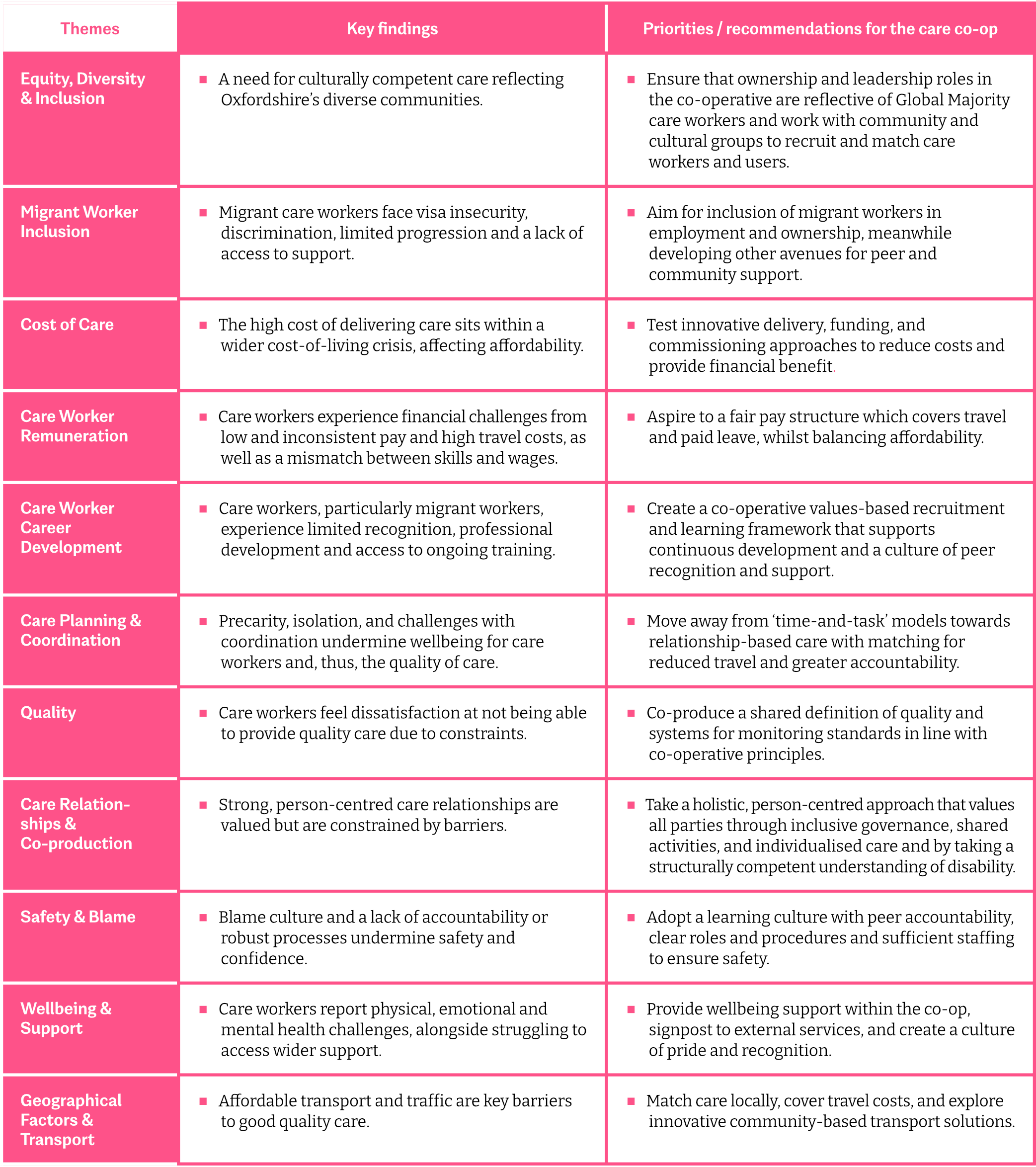
What we learned from existing care co-operatives
Throughout the research project, we learned that care co-operatives put co-operative values at the centre of their businesses through inclusive, participatory decision making and a strong ‘mutual’ culture of relational, co‑created care. Their focus on local teams, community integration, and decentralised management can help build trust, reduce overheads, and strengthen neighbourhood‑based care, creating better experiences for all members. There is also huge potential in raising investment through community‑led finance as well as utilising shared digital infrastructure and resources amongst existing care co‑operatives, enabling economies of scale.
The Great Care Co-op in particular showed that genuine ownership is essential to inclusion for Global Majority and migrant care workers. Reflecting on the learnings from the pilot, steering group member Veronika Susedkova (Director of Co-operative Care Colne Valley) explains, “It’s the intersectional lens the project has used that offers unique and essential learning and challenges to the current dysfunctional care system.” The project has involved both care receivers and care-givers “who are often marginalised global majority care workers facing the hostility of this country’s immigration system, while at the same time doing absolutely essential labour.”
Where next?
We are now in the process of translating these findings into a vision of the next steps towards building co-operative models of care in Oxfordshire. As a result of the research, we have been exploring how the practical setup of a co-op would work.
Whilst we build the supportive environment necessary for a care co-operative to develop, it is important that we respond to the suggestions of the participatory research group. For instance, participants expressed the value of debriefing difficulties with their peers. The research also identified that some care workers, particularly migrant care workers, struggled to access support or information. As a legacy activity from the pilot, we plan to help start a peer support group for care workers, which will be hosted and run by African Families in the UK, one of the pilot project partners. They will provide a regular space for care workers to meet, over food, in a safe, professionally facilitated space for sharing experiences and gaining support from peers. There will also be learning and signposting sessions with other social or community services or unions about support they can access. This may also provide a way to keep prospective members engaged and supported in case the care co-op becomes viable in the future.
We’ve also been working locally to create links and advocate for community wealth building and signposting to local support organisations. We hope to share what we’ve learnt nationally and work with sector bodies such as Co-ops UK to input relevant policy work, and to advocate for changes that would create a more enabling environment for the creation of care co-ops across the UK.
As Veronika continues, “I think this is just a start. With proper resources & local support from the key players within the system, this co-operative partnership could support the emergence of proper community-rooted and -led, inclusive care provision that we all need.”
Find out more on our website: futures.coop/our-work/oxfordshire-care-coop
If you’re interested in working with us – as a care worker, someone accessing care services for yourself or others in your communities, a funder, a commissioning authority, a potential partner organisation, or if you are interested in any other way – please email oxfordshirecarecoop@gmail.com
Rachel Piper is the Community Researcher with Co-operative Futures on the Oxfordshire Care Co-op Pilot Project. She is also the Senior Storytelling Officer at Turn2us, and writes a Substack called Care Curriculum.


.jpg)