I will never forget the day I met Len Maloney. It was a windy lunchtime, the day before the Budget in March 2017, and Len, a VW mechanic, was outside 10 Downing Street. He had travelled there with other small business owners from East London to deliver a petition with over 10,000 signatures to the government calling for fairer business rates. A planned rate hike loomed over Len’s garage and many other small businesses like his. The traders had come together to fight back in a powerful alliance called the East End Trades Guild, coordinated by a visionary community organiser called Krissie Nicolson. Outside that famous black door, flanked by Meg Hillier MP and then Mayor of Hackney Philip Glanville, Len held up the petition. He wore his regulation blue overalls and a woolly hat to ward off the chill. He was smiling, even though he never thought he’d have to turn up at the gates of power just to keep fixing cars in his railway arch.
His battle was personal – and not just about rates. Len had been told by his landlord, Places for London, the property arm of the publicly owned Transport for London, that the rent on his garage near Haggerston Station was tripling, effectively pricing him out of his neighbourhood. Over the next seven years, the Guild exercised every democratic lever they could to keep Len in his arch. There were more petitions and open letters. They organised meetings with Transport for London and members of the Greater London Assembly. They practised how to win support for small businesses at these meetings using community organising techniques. They mobilised around elections, running voter registration drives, encouraging people to check the position of local candidates on fair rents and security of tenure. Len even recorded a single, a cover of the classic Ben E. King anthem ‘Stand By Me’, that was played on BBC Radio and sung, flash mob style, to try and get the attention of the London Mayor outside City Hall.
So it was clear in their minds, after Places for London proceeded to evict Len in 2024, what was necessary to prevent other businesses from suffering the same fate. It would take more than turning up at the gates of power, relying on the goodwill of politicians who had already shown themselves to be unwilling to stand up to global capital. The Guild would continue to employ every democratic means at their disposal to fight for the plight of small businesses – methods that had won them many gains and staved off evictions several times. But they are looking for new premises. This time, they will own the buildings outright.
The UK is in the middle of a crisis of asset stripping. We normally associate the term with corporate raiders and private equity firms that buy undervalued companies and sell off their assets for profit. But we might just as easily apply it to publicly owned bodies like Places for London or to local councils, which have been selling assets since austerity began under David Cameron and George Osborne in 2011. In some of the UK’s poorest communities, councils have accelerated the sale of community centres, daycare centres for the disabled offices, libraries, sports centres, and swimming pools.
Rather than stop the practice, the Labour government has extended the flexible use of funds acquired through sales, which could historically only be used by councils for new buildings or equipment. At the same time, in 2025 the Labour government upgraded local people’s ‘Right to Bid’ on assets councils put up for sale to a ‘Right to Buy’. That means that when a building registered as an ‘asset of community value’ goes up for sale, whether that is a privately owned pub, a publicly owned railway arch, or a council-owned community centre, local people get 12 months to raise the funds to try and buy it, without competition from other bidders. This was an improvement on the community ‘Right to Bid’, which allowed a moratorium of only six months before a sale – and put communities in competition with private buyers, frequently with deeper pockets. But even these upgraded rights, introduced in a Devolution white paper in 2024, have so far proved ineffective at saving publicly owned places from private sale on the open market. Just 2-3% of assets of community value make their way into community hands.

In Hastings, where I live, Jess Steele calls outpricing on the open market of this kind “the modern form of enclosure”. She is referring to the loss of the commons – communal areas of grassland, heathland, fens or moorland – where ordinary people who owned no land could subsist by grazing their animals and collecting firewood. In 1500, around half of England and Wales was common land. These rights were gradually eroded in a process known as enclosure, which was enabled by Acts of Parliament, or “parliamentary enclosure” in the eighteenth and nineteenth centuries. Enclosure removed the rights of ordinary people to steward land between them, so everything became fenced and taxable, owned and controlled.
The political theorist Silvia Federici has shown how older women and those who did or could not work for wages benefitted from common land. When that land was enclosed, some women were forced to go door to door begging for firewood, which coincided with the emergence of the idea of old women as ‘witches’ who might put a hex on your family if they were refused. In this way, the process wasn’t only about land – it was the enclosure of the mind. Older women became targets. People no longer stewarded land in common. We now think of ‘communes’ as weird and cultish. Even our minds have been privatised.
Jess Steele is “commoner at large” in Hastings. She has been the driving force behind the community acquisition of an entire neighbourhood of derelict buildings who come together as the Hastings Commons. These formerly derelict shops and offices have undergone a process of “phased organic redevelopment”. This process makes a virtue of the slow-moving work of renovating the buildings, proceeding in good faith according to the needs of those who step forward and the funding available. Through this approach, the buildings in the neighbourhood have been developed for multiple uses, from providing affordable accommodation for those on housing benefit and hosting youth clubs and tool- and skill-sharing, to creating office space for digital businesses and mental health services. These kinds of activities make people feel they have a stake in the future – and that they are less alone.
When Jess refers to outpricing on the open market as the modern form of enclosure, it is because she considers the empty buildings in Hastings to be common-pool resources. Increasingly, these buildings are former public buildings sold off by cash-strapped councils. Buildings that are owned by the people through their taxes, sold from under them in a market that is far from a level playing field. Private investors rarely see more than the financial value of a building, often overlooking its cultural, historical or social significance. So we have to ask the question: what is this privatisation of our minds doing today? Who is losing out? Once again it’s the people who benefited most from these public spaces: children, the elderly, migrants and refugees, disabled people, racially minoritised peoples. When we are stripped of these places within our towns and cities, vulnerable people become marginalised.
What if, instead of being left to rot or be destroyed, more neglected land and buildings could be rehabilitated? Empty homes might be renovated for those desperately in need of shelter. Empty shops could be reimagined in ways that conserve their embodied energy and celebrate heritage. Vacant or mistreated land might be brought under the stewardship of broad associations of people living nearby, with a vested interest in its proper care. It sounds far-fetched: why would private landlords give up the keys to empty assets, or landowners agree to turn over their fallow land to the hands of the many? The language of our time dictates that these are assets for hoarding. We swim in the soup of our market economies, unable to imagine a way in which collective stewardship might transform the places and the people that we love. But human history is rich with alternatives: the commons, co-operatives, the abundance of gift economies, where giving does not always come with the expectation of receiving. Each has the potential to change the future. Our way of living is leading us to catastrophe. But it has never been the only way.
In Hastings, the buildings are partly held by the community in a community land trust, in a way that protects them from speculators. For the Hastings Commons, owning the buildings is the key to their survival as common-pool resources. The long-term goal is for the shares in all the properties to be fully transferred to the community land trust, where they will be held for the good of the community in perpetuity. This process means the staff, track record, systems, processes, and culture of the social enterprise property company remain, while the community gets 100 per cent ownership of and benefit from the buildings. That company, Hastings Commons, develops as a self-governing ecosystem of organisations engaged in a long experiment to support the White Rock neighbourhood to be self-renovating. It’s a bold endeavour with a long time-horizon, and an antidote to the forces of gentrification that might price local people out.
In London, too, the traders started 2026 by electing Len among five stakeholders on the board of a new London Trades Guild Community Land Trust. The CLT model emerged from the struggle of African Americans in the sixties. A community organiser called Charles Sherrod witnessed first-hand the evictions of African American families and the mass imprisonments that resulted from non-violent efforts to oppose segregation. He decided that the only way to get independence and security was for Black people to own the land themselves. “All power comes from the land,” he noted. In the CLT, they established a kind of organisation that could hold land on behalf of a community in perpetuity.
But it is not the only model. In Birmingham, the community-led initiative CIVIC SQUARE has bought an old tube works in the industrial district in Ladywood and embarked upon its redevelopment as a Neighbourhood Public Square, a place to demonstrate regenerative civic infrastructure like the reuse of materials from the bioregion, the sharing of tools and skills for retrofit, and the spaces for reading, dreaming, and imagining futures beyond the end of capitalism. Rather than a CLT model, CIVIC SQUARE is working on a land covenant, inspired by Kate Raworth’s Doughnut Economics and the Victorian industrialists. The covenant will serve a similar purpose to a CLT, holding the land and the buildings in common, where it can be stewarded by people who live there both now and in the future.

As I write in 2026, 18 months after Len’s eviction, his former arch in the heart of his community sits empty, rubbish drifting across the forecourt where customers used to drop their cars. It makes a farce of the process that led to his eviction, evidence of the senselessness of valuing only profit. When I look at the pictures of that empty arch, I remember the parties held by Len’s customers and friends to help him pack down his arch. The huge Pyrex dishes of barbecue chicken and rice, curries and spring rolls, burgers, sausages, cans of fizzy drinks. The spirit of camaraderie and sense of solidarity. It seemed, to all of us there, that any landlord claiming to work for the people should be able to measure not only financial value but this much stronger thing: the joy and the trust Len cultivated across four decades of service in his neighbourhood.
Len has moved to Leyton, to share premises with one of his customers: a van hire firm and a previous victim of eviction at the hands of Blackstone. Somehow, in the relentless pursuit of profit, publicly owned landlords started aping the predatory practices of the private sector. The Guild has researched the way that Places for London prioritises “Estimated Rental Values” in order to maintain the paper valuation of an asset, creating a perverse incentive to keep the arches empty rather than lower the rent to an affordable level, in the belief that this might devalue their portfolio. Krissie has written about how this prioritises theoretical wealth for the state, rather than the survival of Black-led community assets or small businesses more broadly. “Treating our streets as collateral for an operating surplus is a failure of stewardship. We at the East End Trades Guild refuse to be passive witnesses to this economic injustice,” she says.
Len’s move is temporary. As the Guild establishes community-owned business premises, it is becoming part of a global movement seeking the just return of land, a movement in opposition to the asset-stripping of neighborhoods and the displacement of minoritised peoples. That work, which began a century ago with civil rights movements in the US, is already happening here in the UK, with the pioneering work of CIVIC SQUARE, Hastings Commons, the East End Trades Guild, and many others. Without spaces for all within our towns and cities, we will have nowhere to gather, to shelter, to rest, and to plan in this moment of climate emergency. It is no longer enough to ask for justice – we must learn how to organise for ownership.
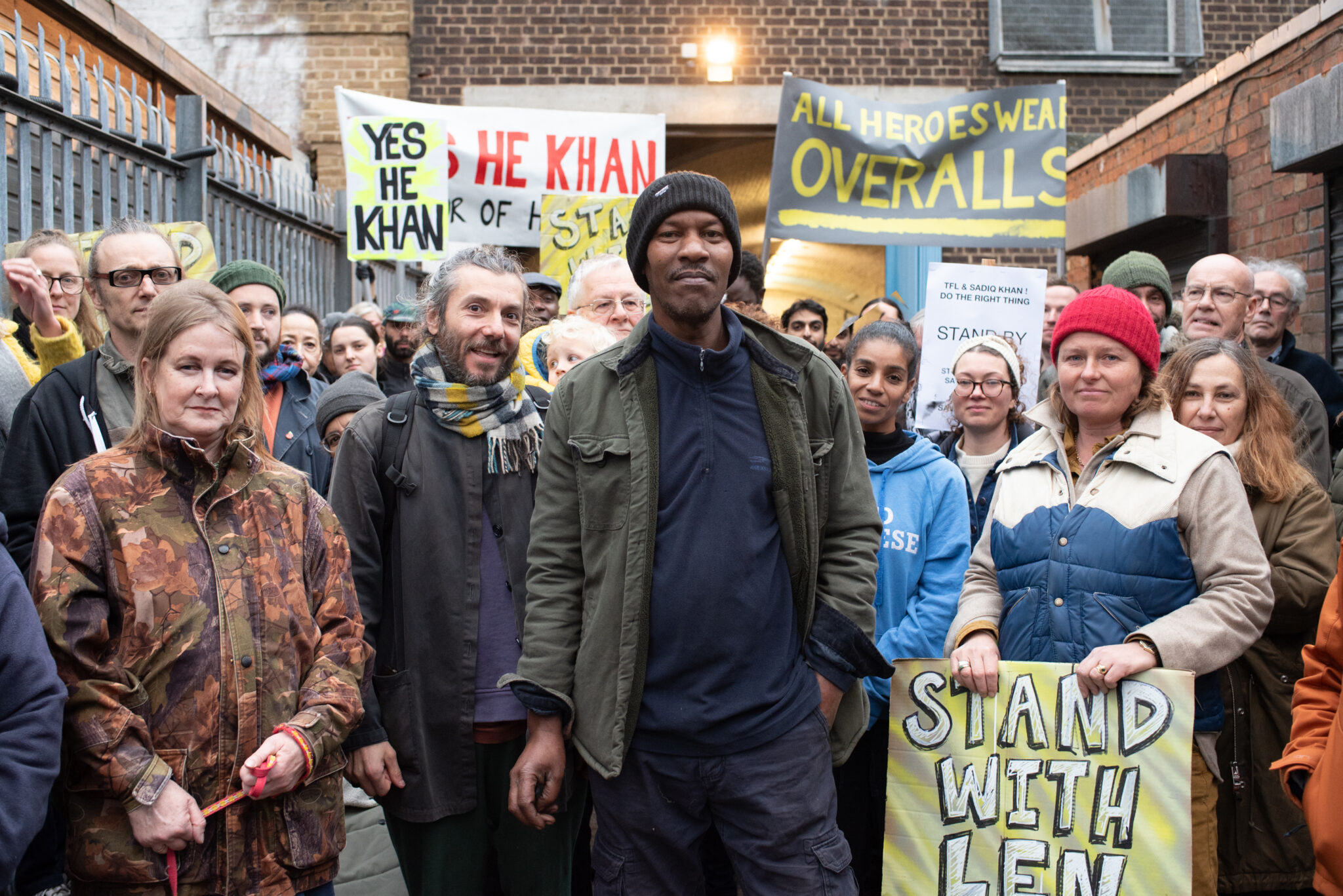
Cover image credit: Sarah Alsinie / A demo held for Len Maloney, JC Motors, on his eviction day
Hazel Sheffield is a business reporter and investigative journalist who has written for the Guardian, Follow the Money and the Financial Times. Before going freelance, she covered derivatives for Euromoney and worked as the business editor of the Independent. In 2016, she started a grant-funded project called farnearer.org, documenting self-organising communities and economic alternatives in the UK. Frontierlands (Torva, 2026) is her first book.