To those familiar with the beer and bingo stereotypes of social clubs, it tends to come as a surprise that the founder of the Working Men’s Club and Institute Union (CIU), Henry Solly, was a teetotal minister. Even less well known is that Solly had been involved in Chartism, the radical campaign to extend the vote beyond landowners and to reform the democratic process.
An analysis of nineteenth-century literature reveals a complex prehistory of the club movement – both its ideologies and its practical plans – rooted partly in Victorian philanthropy with its anxiety to ‘improve’ the masses, as well as in Britain’s first mass working-class political movement. Connecting clubs and Chartism was a belief that change required institutions that facilitated social infrastructure, in which education, leisure, sociability, and democratic participation could be mutually reinforcing. This legacy is worth bringing to light, uncovering along the way not only the influential names inscribed into history, but the foundations laid by their forgotten contemporaries.
Winning over the higher classes
Educationalist and temperance projects in the mid-nineteenth century set out to provide accessible, sociable forms of self-improvement, or alternatives to the public house. It’s these philanthropists, industrialists, and church leaders who Solly credits for the ideas in his 1867 CIU prospectus. Fear of uprising had subsided somewhat after the clashes of early Chartism a few decades earlier, and the revolutionary government of the French Commune would not bring such threats back to the fore until 1871. In this atmosphere, where reform of the working classes was almost a given, his investors would have a hard time arguing against schemes that might cultivate rational and well-mannered workers, understood as being for the public good.
With this in mind, it becomes clearer why Chartism is missing from Solly’s advocacy writing and – to some extent, by consequence – most histories of the CIU. Although they were taken up by the middle classes with a particular vigour, education and temperance were causes that could cut across class and political allegiances; not so much, radical politics. And yet, it appears to have been the ideals of moral Chartism, mixed in with an emergent strand of radical Christianity under the umbrella of Unitarianism, which drove Solly’s famously inexhaustible efforts.

A Chartist idol
Two decades before the establishment of the CIU, the Reverend Henry Solly learned the dangers of more direct, undisguised forms of political advocacy. Won over by the Chartist mission to extend the vote to all men over 21 and reform the existing regulations around ballots, MPs, and constituencies, he travelled to Birmingham in 1842 to participate in the Chartist conference, an attempt to unite factions and class differences within the movement. Consequently, he was forced out of his ministry by a disgruntled congregation back home. From this point onwards, he was more cautious: evidence of the connections between Chartism and the CIU can only be found by digging deeper into his memoirs and fiction written in later life.
Solly was not exactly known as an author – perhaps with good reason. His 1881 novel James Woodford, Carpenter and Chartist was described by The Spectator as “a mixture of political pamphlet and tract, presented under the guise of a novel—in fact, a sugared pill.” Based on the author’s inside experience of Chartism at its peak, it was intended as an introduction to the political, social, and educational aims of Chartist leader William Lovett. Through the polarisation of two fictional friends, Solly praises the ‘moral force’ Chartism espoused by Lovett, and presents its fiery counterpart, physical force, as a moral failing. The moral force protagonist eventually succeeds in winning over his friend, via a text co-written by his idol, Chartism: A New Organization of the People, Embracing a Plan for the Education and Improvement of the People, Politically and Socially.
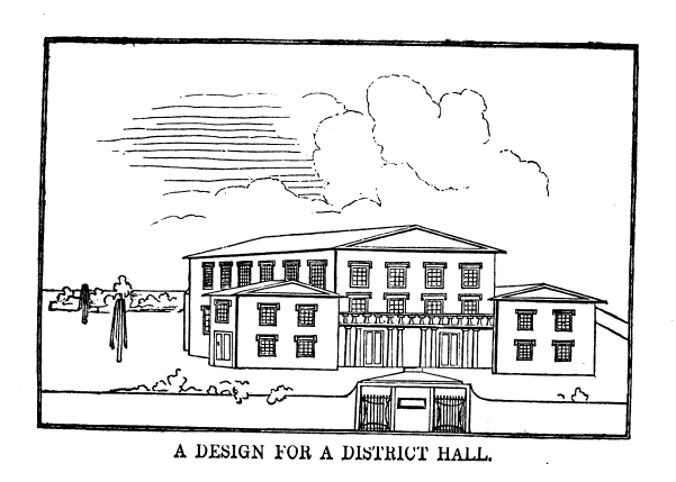
Here the radical influence on working men’s clubs and institutes finally emerges. Chartism, co-written in jail in 1840 by William Lovett and his fellow inmate John Collins, proposes the creation of a network of public, or district, halls. The imagined halls would cut across politics and class, for the purpose of peacefully advancing the cause. These spaces of sociability, education, and political meetings were, similarly to the projects of higher-class reformers, envisaged as non-commercial alternatives to the public house. To drive home the connection, Solly quotes from Chartism and states that the public halls idea contained “the germs of many improvements more recently carried into effect, such as Workmen’s Clubs”.
Politics in a sugared pill?
Unlike clubs and institutes, the public halls were clearly political in intention. They were envisaged as part of a larger project to establish The National Association of the United Kingdom for Promoting the Political and Social Improvement of the People. The Association had three objectives: to unite everyone with an interest in “the political and social improvement of the people” under one body regardless of class; to promote the People’s Charter; and to set up “public halls or schools for the people” in which to provide education and accommodate the meetings and social lives of associations, clubs, and societies. This third objective was intended to facilitate the former two; in other words, the social life within them was merely instrumental to achieving a long-term mission. These predecessors of working men’s clubs, then, were designed primarily as a vehicle for political transformation.
James Woodford never states this explicitly in Solly’s own words, but its quotation of one of the public halls passages from Chartism is framed by a tone of admiration: acceptance of the public halls plan and ideology is presented as the path to self-improvement, and Lovett is even described as the protagonist’s “hero”. It seems that the author was happier to bring more of his political leanings to light in later life, once his influence in the CIU had declined. Even so, this revelation was presented “under the guise of a novel”. The CIU can therefore be understood as a pragmatic counterpart to this literary approach. Men were persuaded to education and temperance – at least, as the focus of the earlier clubs and institutes – by the availability of appealing, homely, and affordable social spaces. Meanwhile, amid receiving funding and support from an elite concerned with the cultivation of moral, rational subjects, the clubs were in fact fostering formal and informal methods of political education, inspired by Lovett’s radical aims.
Existing spaces
Lovett and Collins did not pluck the public halls idea from thin air. As Katrina Navickas identifies in Protest and the politics of space and place, 1789-1848, similar spaces were already emerging within Chartist culture. Having gained more funding and longevity, she writes, radical movements in the late 1830s and ’40s were moving beyond “spaces of making do” towards acquiring buildings for their sole use. The creation of such spaces as alternatives to the limited options available to the working classes was, Navickas insists, a political act.
Whether this represented a new strategy or merely the result of attempts to survive in the public sphere, it was the beginning of a new era for long-term, affordable spaces available to the public, becoming the backdrop to the lives of their local communities. In these alternative institutions, radicalism and workers’ organisations co-existed with entertainment, facilitating the integration of politics into everyday life. Radical entertainments famously blurred the lines between performance and protest, and their spaces absorbed existing cultural practices in music and drama. Women in Chartism, in addition to their contributions to political activity, were often at the forefront of this. They arranged and participated in soirées, tea parties, and gatherings consisting of lectures, readings, songs, and late-night dancing.
Lovett and Collins, Huzza!
Lovett acknowledged the need to assimilate existing cultural practices, but only if reformed. In his 1876 memoirs, echoing his distaste for the singing clubs held in public houses to which he was invited in his youth, he writes, “I hold that no more efficient means for corrupting a people can be found than that of blending their amusements with the means of intoxication.” The Chartism public halls plan therefore recommends that songs that “change and purify” moral character should be sung (compared, presumably, with drinking songs and other pub repertoires), while dancing spaces should be provided with better ventilation.
Solly takes a similar moral stance to Lovett and Collins; in James Woodford, he bemoans one character’s ability to leverage his singing talents for free drinks in the pub. Solly’s prospectus, proposing penny readings interspersed with music and recitations, implies that the weekly presence of wives and children is enough to bring a certain respectability to entertainments. CIU secretary Hodgson Pratt was, however, more scathing, advising that clubs “try to keep up a high standard in the selection of pieces”, while some clubs asked for material to be submitted for advance approval. Pete Brown, author of Clubland: How the Working Men’s Club Shaped Britain, describes this as a clash between the paternalism of the early clubs and the existing working-class traditions that performers and audiences brought into these newer spaces.
Although Solly and the CIU recreated many of the ideas within Chartism, the everyday character of clubs and institutes was shaped by longer-term working-class and radical customs and practices, with which Lovett and Collins had some experience, and became embedded in the movement. The Chartist authors themselves were unable to completely escape the pub singing cultures that concerned them: their release from prison was celebrated with a new ballad sheet to the tune of an old patriotic drinking song, with the refrain ‘Lovett and Collins, Huzza!’
Centralising and amplifying
Henry Solly does seem to have taken on a lot of the movement’s visibility, having appointed himself as its secretary and mouthpiece. As a consequence, twentieth-century histories of the CIU dedicate huge sections to his importance. Some authors have attempted to put Solly back in his place, acknowledging his importance but recognising his tendency towards self-promotion. Similar accusations could be directed at Lovett and Collins: at no point do they mention the existence of similar community spaces that prefigured the change in chartist tactics in the 1840s, from insurrection towards longer-term planning.
But the intentions, in both cases, were to vastly expand an existing phenomenon; to draw inspiration from the best examples of what already existed; to codify the most useful ideologies behind them; and, by centralising them, to make them visible to a wider audience of potential supporters and beneficiaries. To borrow terminology from Cristina Parolin’s 2010 book Radical Spaces, Chartist culture was transforming from the “conditional space” of the public house to the “tenuous liberty” of communities owning their own spaces. Such spaces, inevitably, were vulnerable, from energy companies refusing to supply to them, to costly accusations of illegality in their operations. A central organisation, then, which could provide support and advocacy for such spaces across its network, might have provided a valuable solution.
In practice, Lovett was unsuccessful. He attempted to create a National Hall to implement some of the ideas in Chartism, presumably intended as a central base for an extending network of public halls. When this met with logistical issues, he was eager to blame the rising competition from commercial music hall, directing towards it some of the disdain he held for pub singing. Lovett was unable to move beyond this initial National Hall, which closed in 1857 having achieved few of its aims. Solly, on the other hand, was so effective in centralising a network of clubs and institutes that he was eventually overthrown amid the movement’s expansion under the maturation of its increasingly working-class leadership. Whereas Lovett tried to build a movement by following up his prescriptivist text with a flagship institution, Solly built a federated network, gaining its resilience from supporting and coordinating locally rooted clubs.
Uncovering the foundations
There is still a danger that early histories of working men’s clubs and institutes are disproportionately framed as products of paternalistic middle- and upper-class reform, which contrasts conveniently with their (in the words of T. G. Ashplant) “democratic revolution” later in the nineteenth century. The risk is that modern social clubs might be understood as the inheritors of a battleground between restrictive paternalists and the freedom of the more down-to-earth members. Additionally, it could be argued that, in the long term, social clubs were a depoliticisation of radical ideas, harming the cause of working-class political emancipation. In reality, viewed in the light of Solly’s Chartist leanings, we can see that the relationship between class, power, and politics was far more complex. Bureaucracy, middle-class do-gooders, working-class cultures, and elite funding alike all drove the success of these long-term holistic institutions, underpinned by a reformist political ideology.
Solly and Lovett tapped into existing cultures of self-organising, entertainment, adult education, and mutual support. Readdressing the historical imbalance brings to light not only the political roots of clubs and institutes, but also the continuity and survival of working-class lifestyles and self-organisation across changing institutional structures. Chartism failed to win the Charter, but as club historian Ruth Cherrington notes, autonomy over their leisure spaces was a significant win for the working class. Through these emergent institutions which supported everyday life and cultural practices, many of the ideas and values of Chartism endured.
Isabel Thomas is a postgraduate researcher at Newcastle University, funded by the NUAcT project The Invention of Pop Music: Mainstream Music, Class and Culture, 1520-2020. She uses oral history, archives, media analysis and ethnography to research the music history of working men’s clubs and institutes.